 Appointment
Our Reviews 
 10221 North Cave Creek Road,
 Phoenix, AZ 85020
 Mon – Fri: 8 am – 5.30 pm
Sat – Sun: Closed
 602-241-9888
Appointment
602-241-9888
Appointment
Our Reviews
10221 North Cave Creek Road,
Mon – Fri: 8 am – 5.30 pm602-241-9888
Appointment

 Request Appointment
Phoenix BMW owners experience battery failure earlier and more predictably than BMW owners in virtually any other market. The combination of ambient temperatures exceeding 115 degrees Fahrenheit in summer and pavement temperatures that approach 150 to 160 degrees creates engine bay conditions that accelerate battery chemistry degradation beyond what the factory’s maintenance schedules account for. A BMW AGM battery with a rated service life of five to six years in moderate climates often lasts two to three years in Phoenix. Tanner Motors in Phoenix sees this pattern consistently and approaches BMW battery replacement with the specifics the car’s electronic architecture requires — not just a battery swap, but the registration and coding process that BMW’s charging system depends on.
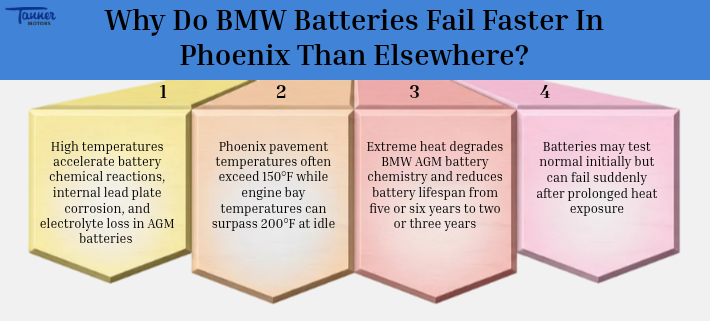
Battery chemistry is sensitive to temperature. The electrochemical reactions inside a lead-acid or AGM battery accelerate at higher temperatures — initially improving performance, but sustained high temperatures also accelerate the corrosion of internal lead plates and cause electrolyte loss even in sealed AGM designs.
Phoenix pavement temperatures regularly exceed 150 degrees Fahrenheit, and engine bay temperatures at idle can exceed 200 degrees. A BMW AGM battery in this environment has its internal chemistry degraded at a rate that shortens a typical service life from five or six years to two or three. The battery may test within acceptable parameters in October but fail completely in the following July. Tanner Motors recommends Phoenix BMW owners test their battery annually rather than waiting for a no-start event. Schedule a BMW battery test at Tanner Motors in Phoenix, AZ.
BMW’s Intelligent Battery Sensor is mounted directly on the negative terminal of the battery and monitors battery voltage, current flow, and temperature in real time. The DME and electrical management module use this data to determine the battery’s state of charge and state of health, which controls the alternator‘s charging behavior.
When a BMW battery is replaced, the IBS and the DME must be informed that a new battery has been installed — this is called battery registration or coding. Without this step, the DME continues managing charging based on the old, degraded battery’s profile. The result is typically undercharging of the new battery — the DME thinks the battery is nearly full when it is not, which shortens the new battery’s life dramatically. Tanner Motors performs the registration as a standard part of every BMW battery replacement. Contact Tanner Motors in Phoenix about BMW battery replacement with proper coding.
If a new battery continues to discharge rapidly after replacement, a parasitic draw may be the cause — a module that stays active when it should sleep, or an aftermarket accessory draining current continuously. BMW’s complex electronics mean multiple modules stay partially active after shutdown to maintain memory functions.
A battery that dies after three to five days of not driving the car — even with a new battery — is a classic parasitic drain pattern. Tanner Motors uses an ammeter and a systematic relay and fuse elimination to identify abnormal current draws after a timed post-shutdown period. Common culprits include aftermarket audio systems, GPS trackers, and occasionally a failing body control module. Book a BMW battery and electrical system diagnosis at Tanner Motors in Phoenix.
The correct replacement battery must match the original BMW specification in both chemistry (AGM) and cold-cranking amperage (CCA) rating. Installing a battery with a higher or lower CCA than specified causes the DME’s battery management calculations to be inaccurate even after registration. Tanner Motors sources BMW-compatible AGM batteries with the correct specification for each model.
After installation and registration, Tanner Motors tests the charging system output to confirm the alternator is delivering the correct voltage with the new battery in the circuit, and monitors the battery charge acceptance to confirm the new unit is charging correctly in Phoenix’s demanding thermal environment.
Q: How do I know if my BMW needs a new battery versus a charge?
A: A battery that takes a charge and holds it normally during subsequent drives likely just needs charging. A battery that loses charge rapidly after a full charge, or that shows significantly reduced cold-cranking performance (slow engine crank), needs replacement. Tanner Motors performs a load test that distinguishes between these conditions accurately.
Q: Can I replace a BMW battery myself without the coding step?
A: You can replace the battery physically, but without the IBS registration, the charging system will not manage the new battery correctly. The coding step requires BMW diagnostic software. Tanner Motors performs the complete replacement and coding as a single service.
Q: Does Tanner Motors service other BMW models besides sedans?
A: Yes — Tanner Motors services the full BMW lineup, including 3, 4, 5, 6, 7, and 8 Series, all X models, Z4, and M performance variants. Contact the shop to confirm service availability for your specific BMW.
Q: Does Tanner Motors service other European brands besides BMW in Phoenix?
A: Yes — Tanner Motors services Mercedes, Audi, Porsche, Volkswagen, and other European brands alongside BMW. Contact the shop to confirm service availability for your specific vehicle.

Tanner Motors Customer Satisfaction Score of 99.99 % is based on 196 votes and 196 reviews over 6 months Certified AutoVitals Reviews
Site Design & Marketing by 
10221 North Cave Creek Road Phoenix, AZ 85020Mon – Fri: 8 am – 5.30 pm

Site Design & Marketing by 