 Appointment
Our Reviews 
 10221 North Cave Creek Road,
 Phoenix, AZ 85020
 Mon – Fri: 8 am – 5.30 pm
Sat – Sun: Closed
 602-241-9888
Appointment
602-241-9888
Appointment
Our Reviews
10221 North Cave Creek Road,
Mon – Fri: 8 am – 5.30 pm602-241-9888
Appointment

 Request Appointment
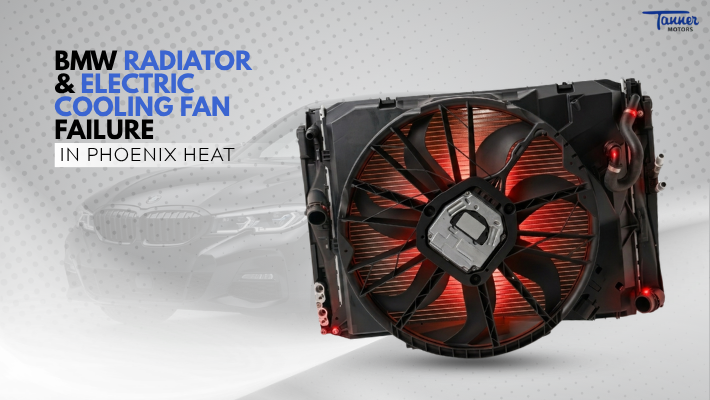
Cave Creek Road at 5 p.m. in August. Traffic crawls. The temp needle on your 328i drifts right of center and the vents go lukewarm. That combination points at the cooling fan or the radiator, and on a BMW in Phoenix heat neither part waits politely for a convenient week to fail.
BMW’s plastic radiator tanks and its electronically controlled fan both live on a heat clock, and 110-degree pavement runs that clock fast. Skipping cooling maintenance is a false economy. AAA puts maintenance, repair and tire costs on a newer vehicle at roughly 10 cents per mile, about $1,500 a year at 15,000 miles, and one overheating event can eat that budget twice over.
BMW stopped using engine-driven fans on most models years ago, and what replaced them is a brushless electric fan with the control electronics potted into the shroud. It moves air quietly. It also puts the failure point on a circuit board six inches behind a radiator that dumps 200-degree heat into it all summer.
When the module cooks, the fan either stops, runs at one fixed speed, or roars at full tilt the moment you turn the key. The blades are fine. Codes in the 2E8x range usually come with it. On an X5 or a 335i, that shroud is a several-hundred-dollar part before anyone touches a wrench.
The core is aluminum, the tanks are plastic, and they’re crimped together with a gasket between them. Heat cycles that joint thousands of times a year. Plastic always loses. Phoenix does it harder than almost anywhere, and after four or five summers the plastic goes chalky and splits, usually along the crimp, usually where a hose stub meets the tank.
Look for dried pink or blue residue on the fan shroud. A cracked coolant expansion tank behaves the same way and gets misdiagnosed as a radiator all the time. Both parts are cheap. The consequences are not.
An N52 or N55 that gets hot enough to blow the expansion tank cap can warp an aluminum head, and the head gasket goes with it. That repair runs into the thousands. Oil-cooled turbos on the N54 and N55 also cook their oil when coolant flow drops, which surfaces later as timing chain and bearing wear that nobody connects back to a fan that died in July.
The cheap version of this story ends with a diagnostic fee and a fan. The expensive version ends with a long-block. Pull over. Don’t try to make it home on a climbing needle.
Two tests separate the possibilities in about an hour. A scan tool commands the fan through its full speed range while we watch duty cycle and current draw. That tells us whether the module is dead, the signal is missing, or the fan is simply being told not to run. No guessing.
A cooling system pressure test at 15 psi finds seam leaks that only weep when hot and vanish on a cold inspection. Thermostats stick open on these cars too, which reads as a slow warmup rather than an overheat. Coolant condition matters as well. Old coolant loses its corrosion inhibitors, and then it starts eating water pump seals and the aluminum passages in the head from the inside out.
Every four years or 40,000 miles, whichever lands first. BMW coolant isn’t interchangeable with the green universal stuff at the parts store, since older cars want the blue G48-type formula and newer ones want HT-12 violet, and mixing them kills corrosion protection. Read the cap.
Drain, refill, bleed properly with the electric water pump routine, and check fan operation while the hood is already open. Boring work. Cheap insurance. Ten years of it costs less than one head gasket, and hoses that have gone hard and shiny at the clamp get flagged at every oil change before they turn into the next leak.
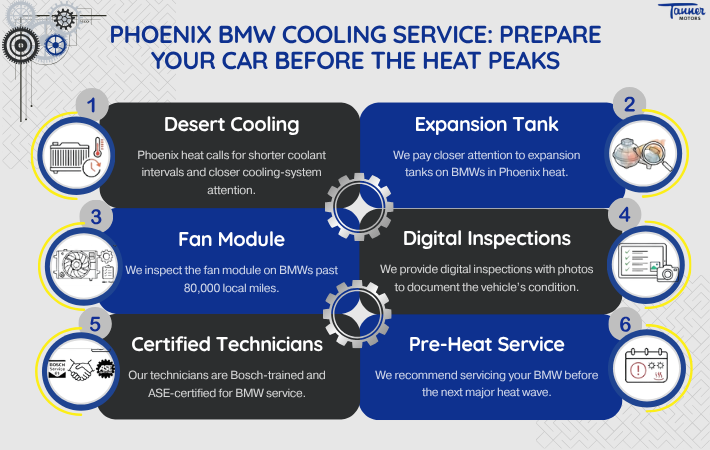
This has been a family shop on North Cave Creek Road since 2004, and Phoenix cars are the only cars we see. Heat rewrites the schedule. Desert duty cycles change what we recommend: shorter coolant intervals, closer attention to expansion tanks, and a hard look at the fan module on any BMW past 80,000 local miles.
Bosch-trained techs, digital inspections with photos, ASE certification. Come in before August. If your BMW is due, the week before a heat wave is a much better appointment than the afternoon of one.
Q: Why is my BMW overheating in stop-and-go traffic but fine on the freeway?
A: That pattern points straight at the electric cooling fan. At highway speed air moves through the radiator on its own, but at idle the fan has to do the work, so a dead fan module shows up in traffic first.
Q: How long does a BMW electric cooling fan last?
A: In Phoenix, plan on eight to ten years or roughly 100,000 miles. The blades outlive the electronics. Those sit right behind the radiator and slowly bake.
Q: Can I drive my BMW with a small coolant leak?
A: Not far. A weeping radiator seam becomes a split seam without warning, and BMW aluminum heads warp fast once the coolant level drops below the pump.
A fan test and a pressure test take about an hour and tell you exactly where you stand. Book the hour. Bays are open this month.

Tanner Motors Customer Satisfaction Score of 99.99 % is based on 196 votes and 196 reviews over 6 months Certified AutoVitals Reviews
Site Design & Marketing by 
10221 North Cave Creek Road Phoenix, AZ 85020Mon – Fri: 8 am – 5.30 pm

Site Design & Marketing by 