 Appointment
Our Reviews 
 10221 North Cave Creek Road,
 Phoenix, AZ 85020
 Mon – Fri: 8 am – 5.30 pm
Sat – Sun: Closed
 602-241-9888
Appointment
602-241-9888
Appointment
Our Reviews
10221 North Cave Creek Road,
Mon – Fri: 8 am – 5.30 pm602-241-9888
Appointment

 Request Appointment

There is no light for this one. No noise, no rough idle, no gradual decline you can plan around. A Volvo timing belt runs quietly right up until a tooth strips or the belt snaps, and then the camshafts stop while the crankshaft keeps turning.
On these engines that means valves meeting pistons, and the bill goes from a scheduled service to an engine rebuild in about a second and a half. Tanner Motors is a Bosch Car Service shop on North Cave Creek Road in Phoenix, and belt intervals are the one piece of Volvo maintenance we push people on, because Arizona is harder on rubber than the maintenance schedule assumes. If your S60, V70 or XC90 sat through the summer and you are about to start using it again, read the interval before you load it up for Flagstaff.
The math is not subtle. A timing belt keeps the camshafts and the crankshaft turning in agreement, and in an interference engine — which is what these are — the valves swing down into space the pistons also use, safely, for as long as the belt keeps its teeth on the sprockets. Then it doesn’t.
Break the belt and the pistons arrive first. Bent valves. Damaged guides, sometimes a scored piston crown, and a cylinder head that has to come off to find out how bad it really is. Owners who have paid for that never ask about the interval again.
Rubber does not wear out in a Volvo timing case. Heat is the driver. It hardens, loses grip on the sprocket teeth, and cracks between the ribs.
Consider what an engine bay here lives through. NOAA’s 1991-2020 normals put the average July high at Phoenix Sky Harbor at 106.5 degrees, and under-hood temperatures on a car sitting on hot asphalt in Deer Valley run well above the outside air, month after month, for the entire life of the belt. That is a different aging curve than the same car would see in Portland.
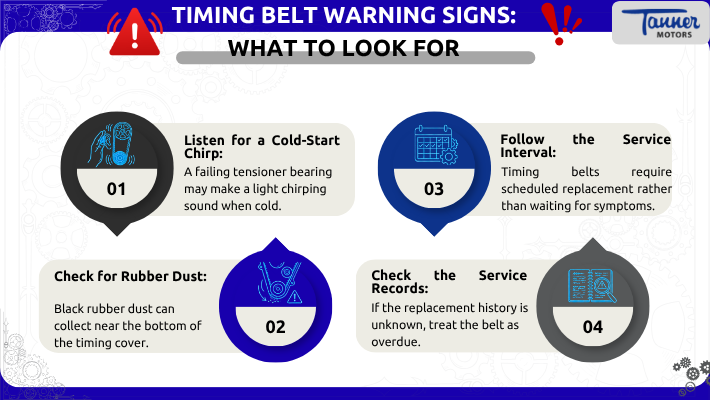
So we go by whichever comes first, the mileage or the years. Most Volvo schedules put belt replacement between 100,000 and 120,000 miles depending on engine and model year, with a time limit alongside it, and in a climate where the car spends a decade of afternoons parked on hot asphalt the time limit is almost always the one that expires first. Age wins here.
Replace the belt alone and you pay twice. The tensioner is a hydraulic or spring-loaded component ageing on the same clock, and the smooth idler pulleys spin on bearings that have made the same millions of revolutions.
On many Volvo engines the water pump is driven by the timing belt itself. If yours is one of them, the pump is already exposed with everything apart — replacing it then costs a pump and a gasket, and replacing it two years later costs the entire belt job again. Do the kit.
You will not hear it coming. Occasionally there is a light chirp at cold start from a dying tensioner bearing, and occasionally black rubber dust collects at the bottom of the timing cover.
That is the whole list. This is why the service is time-based instead of symptom-based, and why we would rather read your maintenance records than wait for a complaint.
If nobody can tell you when the belt was last done, treat it as never done. Records get lost with the second owner, and on a 2004 XC90 that assumption is almost always correct.
Half of Phoenix parks a car for the hottest months. Snowbirds fly out in May, the garage door closes, and the car comes back into service around now with the same odometer reading it had in spring.
The belt did not rest. It sat under tension, in heat, taking a set on the sprocket it was wrapped around, while the tensioner held pressure for four months without moving. Cars that sit need belts sooner than cars that get driven, and the same goes for the coolant hoses in the same engine bay.
Check it before the first long trip of the season. Interstate 17 climbs several thousand feet out of the valley, and a marginal belt does not improve under that load.
We are at 10221 North Cave Creek Road, minutes from Moon Valley and Sunnyslope. Service history stays on file, so your next visit starts with what the car actually had done.
Bosch Car Service is the standard this shop works to, and Volvo is one of six makes we specialise in, alongside Audi, BMW, Lexus, Mercedes-Benz and MINI. Bring the records if you have them. If you do not, we will read the belt, the tensioner and the covers and tell you where you stand.
Q: When should a Volvo timing belt be replaced?
A: Most Volvo schedules call for it between 100,000 and 120,000 miles, with a time limit running alongside the mileage. In Phoenix the years usually expire before the miles do, so check the date of the last replacement.
Q: What happens if a Volvo timing belt breaks?
A: The camshafts stop and the crankshaft keeps going, so valves and pistons collide. Expect bent valves at minimum, often a cylinder head that has to come off for inspection. It is one of the few failures that can total a healthy engine.
Q: Does the water pump need to be replaced with the timing belt?
A: On many Volvo engines the water pump is belt-driven, so it is already fully exposed during the job. Replacing it then adds a modest amount to the bill; replacing it later means paying for the entire belt access again.
Q: Is a timing belt still needed on newer Volvos?
A: Yes, on plenty of them. Volvo stayed with belts far longer than most manufacturers, so a newer four-cylinder can still have a scheduled belt replacement in its book. The interval differs by engine.
Bring the car in and we will pull the upper cover, check the belt’s condition and date, inspect the tensioner and seals, and give you a straight answer on whether it can wait. Scottsdale, Glendale, Peoria and Cave Creek owners are all a short drive away.

Tanner Motors Customer Satisfaction Score of 99.99 % is based on 196 votes and 196 reviews over 6 months Certified AutoVitals Reviews
Site Design & Marketing by 
10221 North Cave Creek Road Phoenix, AZ 85020Mon – Fri: 8 am – 5.30 pm

Site Design & Marketing by 