 Appointment
Our Reviews 
 10221 North Cave Creek Road,
 Phoenix, AZ 85020
 Mon – Fri: 8 am – 5.30 pm
Sat – Sun: Closed
 602-241-9888
Appointment
602-241-9888
Appointment
Our Reviews
10221 North Cave Creek Road,
Mon – Fri: 8 am – 5.30 pm602-241-9888
Appointment

 Request Appointment
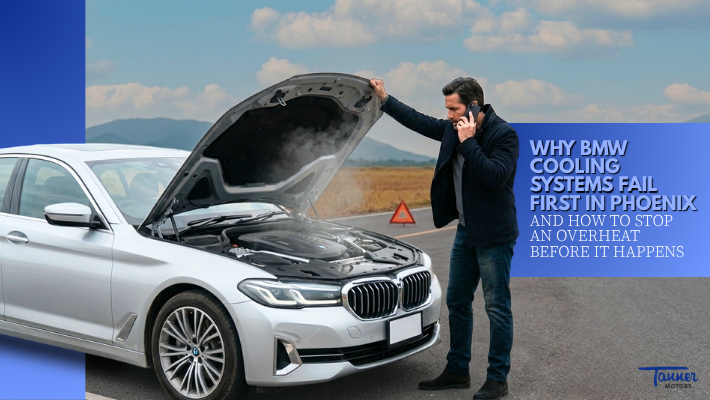
Phoenix BMW owners learn quickly this city is uniquely hostile to cooling systems. Temperatures above 115 degrees, pavement past 150, and engine-bay heat in stop-and-go traffic on Cave Creek Road, the 51, and I-17 age components far faster than BMW’s schedules – written for moderate climates – anticipated. A water pump or thermostat housing that lasts a decade in the Northeast can fail in three or four Phoenix summers. Tanner Motors has serviced BMWs in the Valley for over two decades and sees the same pattern yearly: marginal parts that survived winter give out under the first sustained heat. Getting ahead of it is the difference between a planned repair and a roadside disaster.
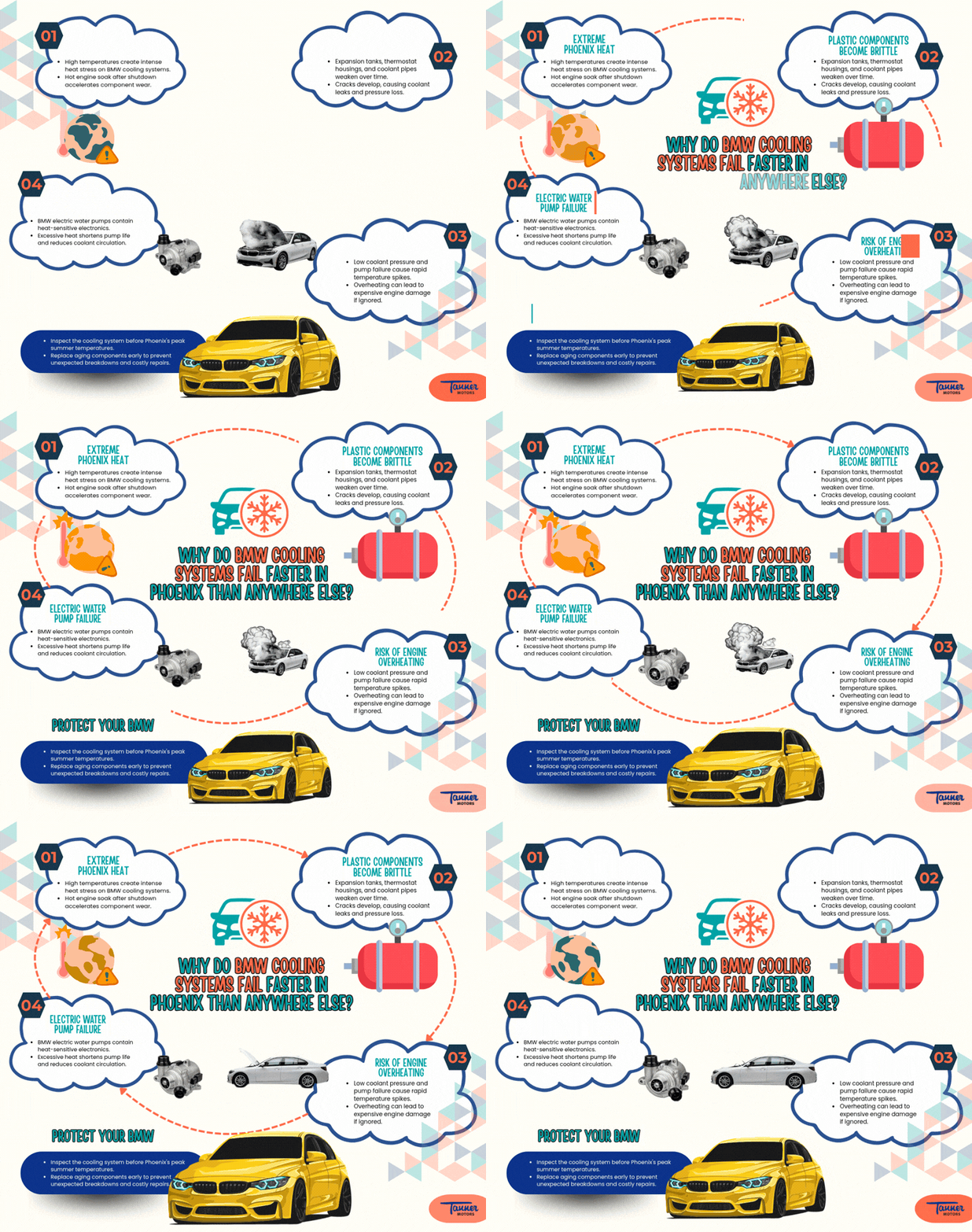
Heat is the enemy of every cooling component. BMW engines run a pressurized system with many lightweight plastic parts – the expansion tank, thermostat housing, and coolant pipes – chosen to save weight and resist corrosion. Phoenix delivers the most aggressive heat cycling anywhere: blistering highs, hot soak after shutdown, and engine-bay temperatures past 200 degrees in summer traffic. Over a few seasons the plastic grows brittle and cracks at a stressed seam, the system loses pressure, and the engine overheats faster than expected.
BMW’s electric water pump adds another heat-sensitive element. Unlike an old belt-driven pump, it contains electronics degraded by sustained high temperatures, and Phoenix heat shortens their life significantly. When the pump fails, circulation stops and temperature spikes quickly. The U.S. Department of Energy notes that engines running outside their designed temperature range lose efficiency and accelerate wear (energy.gov). Schedule a BMW cooling system inspection at Tanner Motors in Phoenix before the peak of summer.
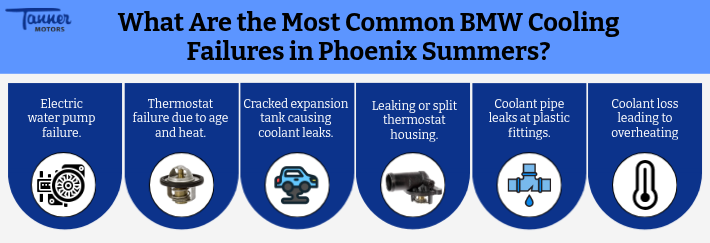
The electric water pump leads the list. As it ages in Phoenix heat, it can fail electrically and stop circulating coolant, often with little warning beyond a sudden temperature climb and a dashboard alert. Because the pump and thermostat are commonly replaced together – and the labor overlaps – many owners address both proactively at a high-mileage threshold rather than waiting for a freeway failure.
Plastic coolant components are the other major culprit. The expansion tank cracks, the thermostat housing seeps or splits, and coolant pipes leak at their plastic fittings. Any of these drops pressure and lets coolant escape, and in Phoenix heat a small leak can empty a system quickly. A leak rarely stays isolated: lost coolant means an overheat, and an overheat threatens the head gasket and head. Contact Tanner Motors in Phoenix to have the cooling system pressure-tested and the failure point identified.
This is where a cooling failure becomes genuinely expensive. BMW engines use aluminum cylinder heads, and aluminum warps when it exceeds its designed temperature. A head that warps even slightly breaks the head-gasket seal, letting coolant and combustion gases mix – and the repair jumps from a few hundred dollars of cooling parts to a head gasket job that may require machining the head, often a four-figure repair. A severe overheat can damage the engine beyond economical repair.
The damage can occur within minutes of the gauge entering the red. The instinct to “just make it home” is what converts a fixable leak into engine-replacement territory. The correct response is to pull over safely, shut down, and let it cool before arranging an inspection. Acting on the first warning keeps these repairs small.
The most effective prevention is a pressure test and coolant condition check before the heat peaks. A pressure test holds the system at operating pressure to reveal leaks that hide when the engine is cold, while a condition check confirms the fluid still carries its corrosion and boiling-point protection. Schedule a BMW cooling inspection at Tanner Motors in Phoenix and address weaknesses on your schedule.
On higher-mileage BMWs in this climate, a proactive cooling-system refresh – replacing the electric water pump, thermostat, and the most failure-prone plastic parts together – is far cheaper than replacing each as it fails, because most labor is shared. Given how reliably Phoenix heat finds these weak points, that bundled approach removes the summer-breakdown risk almost entirely and is a strategy Tanner Motors recommends for cars approaching the mileage where these failures cluster.
Q: Does Tanner Motors replace BMW electric water pumps and thermostats?
A: Yes – Tanner Motors replaces BMW electric water pumps and thermostats and performs full cooling system service with factory-level diagnostics. Contact the shop to schedule an inspection or replacement.
Q: How do I know if my BMW cooling system is at risk in Phoenix heat?
A: A pressure test and coolant condition check are the most reliable indicators. High mileage, an original water pump, a low-coolant message, or any coolant smell are all reasons to inspect. Tanner Motors can evaluate your car.
Q: My BMW temperature gauge climbs in traffic but settles on the highway – what does that mean?
A: That pattern often points to a weak electric cooling fan or a restricted radiator, since low-speed cooling depends on the fan. Tanner Motors can diagnose whether it is the fan, radiator, or water pump.
Q: Does Tanner Motors service other European brands besides BMW in Phoenix?
A: Yes – Tanner Motors services BMW, MINI, Volvo, and other European brands. Contact the shop to confirm availability.

Tanner Motors Customer Satisfaction Score of 99.99 % is based on 196 votes and 196 reviews over 6 months Certified AutoVitals Reviews
Site Design & Marketing by 
10221 North Cave Creek Road Phoenix, AZ 85020Mon – Fri: 8 am – 5.30 pm

Site Design & Marketing by 