 Appointment
Our Reviews 
 10221 North Cave Creek Road,
 Phoenix, AZ 85020
 Mon – Fri: 8 am – 5.30 pm
Sat – Sun: Closed
 602-241-9888
Appointment
602-241-9888
Appointment
Our Reviews
10221 North Cave Creek Road,
Mon – Fri: 8 am – 5.30 pm602-241-9888
Appointment
 Request Appointment
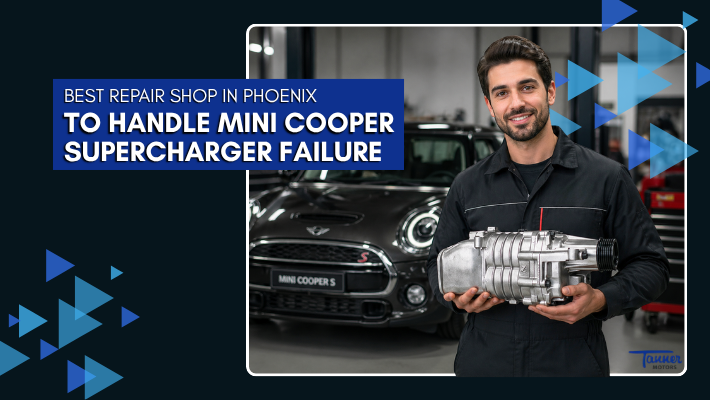
The Mini Cooper S is one of the most entertaining small cars ever built — and a significant contributor to that fun factor is the Roots-type supercharger fitted to the first-generation R53 model’s 1.6-liter engine. This forced induction system gives the Cooper S its signature whine and delivers immediate, linear power across the entire RPM range. But superchargers are mechanical components that experience wear, and when they begin to fail, the Cooper S’s performance and reliability suffer dramatically. At Tanner Motors in Phoenix, Arizona, our MINI specialists have extensive experience diagnosing and repairing supercharger failures on R53 Cooper S models.
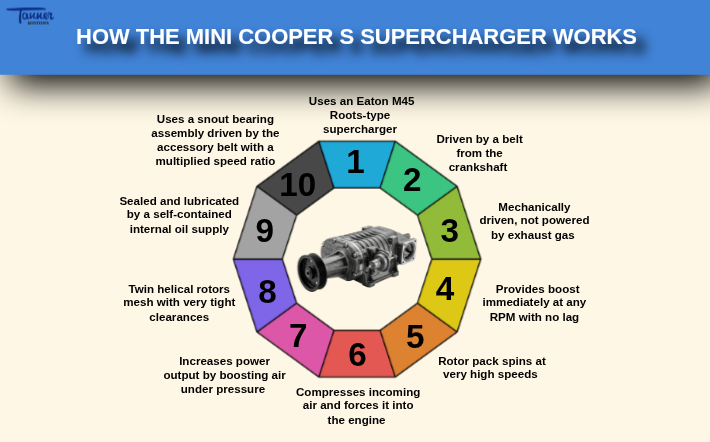
The R53 Mini Cooper S uses an Eaton M45 Roots-type supercharger driven by a belt from the crankshaft. Unlike turbochargers that are powered by exhaust gas, a supercharger is mechanically driven and therefore provides boost immediately at any RPM — with no lag. The supercharger rotor pack spins at very high speeds, compressing incoming air and forcing it into the engine under pressure for increased power output.
Inside the supercharger, twin helical rotors mesh together with very tight clearances, sealed and lubricated by a self-contained internal oil supply. The supercharger also uses a snout bearing assembly at the drive end that allows the unit to be driven via the accessory belt while the rotor pack operates at a multiplied speed ratio.
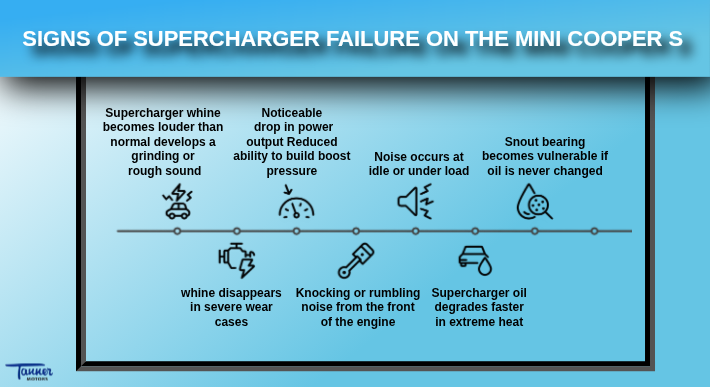
The most recognizable sign is a change in the characteristic supercharger whine — it may become louder, take on a grinding or rougher quality, or disappear almost entirely in cases of severe internal wear. Power output drops noticeably as internal clearances increase and the rotor pack loses its ability to build boost pressure effectively. A worn snout bearing may produce a knocking or rumbling noise from the front of the engine at idle or under load, which is distinctly different from the normal induction whine.
In Phoenix’s extreme heat, supercharger oil degradation can be accelerated, and the snout bearing is particularly vulnerable if the supercharger oil has never been changed — a service that many owners are unaware exists.
Our ASE-certified technicians perform a full assessment of the supercharger’s condition before recommending replacement or rebuild. In many cases, a snout bearing replacement or an oil change addresses the noise without requiring a complete supercharger replacement. When the rotor pack itself has worn beyond acceptable tolerances, we replace the supercharger unit with a quality remanufactured or new assembly. We also inspect the intercooler and boost piping for cracks or leaks that can reduce performance and place additional load on the supercharger. Contact us to get started.
Address: 10221 N Cave Creek Rd, Phoenix, AZ 85020
Phone: (602) 241-9888
Website: tanner-motors.com
Q: How often should the Mini Cooper S supercharger oil be changed?
A: MINI recommends changing the supercharger oil every 40,000 to 50,000 miles. Many R53 owners have never had this service performed, which contributes to premature snout bearing failure. We include this service as part of any supercharger inspection.
Q: Can the Mini Cooper S supercharger be rebuilt instead of replaced?
A: Yes. Professional supercharger rebuilds that replace the internal bearings, seals, and worn rotor components are available and can be a cost-effective alternative to a complete replacement. The condition of the rotor pack determines whether a rebuild is viable.
Q: Will a failing supercharger damage my Mini Cooper S engine?
A: A supercharger that is losing boost due to internal wear reduces power but typically does not cause direct engine damage. However, a failing snout bearing that seizes can cause the drive belt to fail or jam, which can damage the belt drive system and cause a no-start situation.
Q: Does Tanner Motors service other MINI models beyond the R53?
A: Yes. We service all MINI models including R56, R60, F55/F56 generation vehicles, and both turbocharged and naturally aspirated variants.

Tanner Motors Customer Satisfaction Score of 99.99 % is based on 196 votes and 196 reviews over 6 months Certified AutoVitals Reviews
Site Design & Marketing by 
10221 North Cave Creek Road Phoenix, AZ 85020Mon – Fri: 8 am – 5.30 pm

Site Design & Marketing by 